bitcoin: An early experimental Ethereum token created in 2015
Token Information
Key Facts
Description
On November 3, 2015, Fabian Vogelsteller and Alex van de Sande released the Ethereum Wallet with built-in contract deployment and token support. This was a significant innovation, as it marked the beginning of what would later become the ERC-20 token standard. At the time, the Ethereum Wallet team was actively working on defining a standardized token framework for Ethereum. With the Beta 3 release of the Ethereum Wallet, the first practical framework was made available and opened up for real-world testing.
This release sparked a wave of tokens created by early Ethereum enthusiasts. One of the earliest examples was a token named “bitcoin”, a simple token designed to replicate Bitcoin’s original fixed supply of 21 000 000 units. It was created by a user known as spiderwars after a comment appeared in the Ethereum Wallet release thread on Reddit asking: “So who is going to start the token ‘bitcoin’ with 21M available?”
Following its creation, spiderwars distributed the “bitcoin” tokens freely to other Reddit users, including Fabian Vogelsteller and various members of the early Ethereum community.
One user reportedly offered 10 Ether in exchange for 1 million “bitcoin” tokens, making this one of the earliest documented over-the-counter token trades on Ethereum.
spiderwars initially made an error by creating a token with a total supply of 0.21 bitcoin before correcting it to the intended 21 000 000 supply.
On November 3, 2015, Fabian Vogelsteller and Alex van de Sande released the Ethereum Wallet with built-in contract deployment and token support. This was a significant innovation, as it marked the beginning of what would later become the ERC-20 token standard. At the time, the Ethereum Wallet team was actively working on defining a standardized token framework for Ethereum. With the Beta 3 release of the Ethereum Wallet, the first practical framework was made available and opened up for real-world testing.
This release sparked a wave of tokens created by early Ethereum enthusiasts. One of the earliest examples was a token named “bitcoin”, a simple token designed to replicate Bitcoin’s original fixed supply of 21 000 000 units. It was created by a user known as spiderwars after a comment appeared in the Ethereum Wallet release thread on Reddit asking: “So who is going to start the token ‘bitcoin’ with 21M available?”
Following its creation, spiderwars distributed the “bitcoin” tokens freely to other Reddit users, including Fabian Vogelsteller and various members of the early Ethereum community.
One user reportedly offered 10 Ether in exchange for 1 million “bitcoin” tokens, making this one of the earliest documented over-the-counter token trades on Ethereum.
spiderwars initially made an error by creating a token with a total supply of 0.21 bitcoin before correcting it to the intended 21 000 000 supply.
On November 3, 2015, Fabian Vogelsteller and Alex van de Sande released the Ethereum Wallet with built-in contract deployment and token support. This was a significant innovation, as it marked the beginning of what would later become the ERC-20 token standard. At the time, the Ethereum Wallet team was actively working on defining a standardized token framework for Ethereum. With the Beta 3 release of the Ethereum Wallet, the first practical framework was made available and opened up for real-world testing.
This release sparked a wave of tokens created by early Ethereum enthusiasts. One of the earliest examples was a token named “bitcoin”, a simple token designed to replicate Bitcoin’s original fixed supply of 21 000 000 units. It was created by a user known as spiderwars after a comment appeared in the Ethereum Wallet release thread on Reddit asking: “So who is going to start the token ‘bitcoin’ with 21M available?”
Following its creation, spiderwars distributed the “bitcoin” tokens freely to other Reddit users, including Fabian Vogelsteller and various members of the early Ethereum community.
One user reportedly offered 10 Ether in exchange for 1 million “bitcoin” tokens, making this one of the earliest documented over-the-counter token trades on Ethereum.
spiderwars initially made an error by creating a token with a total supply of 0.21 bitcoin before correcting it to the intended 21 000 000 supply.
On November 3, 2015, Fabian Vogelsteller and Alex van de Sande released the Ethereum Wallet with built-in contract deployment and token support. This was a significant innovation, as it marked the beginning of what would later become the ERC-20 token standard. At the time, the Ethereum Wallet team was actively working on defining a standardized token framework for Ethereum. With the Beta 3 release of the Ethereum Wallet, the first practical framework was made available and opened up for real-world testing.
This release sparked a wave of tokens created by early Ethereum enthusiasts. One of the earliest examples was a token named “bitcoin”, a simple token designed to replicate Bitcoin’s original fixed supply of 21 000 000 units. It was created by a user known as spiderwars after a comment appeared in the Ethereum Wallet release thread on Reddit asking: “So who is going to start the token ‘bitcoin’ with 21M available?”
Following its creation, spiderwars distributed the “bitcoin” tokens freely to other Reddit users, including Fabian Vogelsteller and various members of the early Ethereum community.
One user reportedly offered 10 Ether in exchange for 1 million “bitcoin” tokens, making this one of the earliest documented over-the-counter token trades on Ethereum.
spiderwars initially made an error by creating a token with a total supply of 0.21 bitcoin before correcting it to the intended 21 000 000 supply.
On November 3, 2015, Fabian Vogelsteller and Alex van de Sande released the Ethereum Wallet with built-in contract deployment and token support. This was a significant innovation, as it marked the beginning of what would later become the ERC-20 token standard. At the time, the Ethereum Wallet team was actively working on defining a standardized token framework for Ethereum. With the Beta 3 release of the Ethereum Wallet, the first practical framework was made available and opened up for real-world testing.
This release sparked a wave of tokens created by early Ethereum enthusiasts. One of the earliest examples was a token named “bitcoin”, a simple token designed to replicate Bitcoin’s original fixed supply of 21 000 000 units. It was created by a user known as spiderwars after a comment appeared in the Ethereum Wallet release thread on Reddit asking: “So who is going to start the token ‘bitcoin’ with 21M available?”
Following its creation, spiderwars distributed the “bitcoin” tokens freely to other Reddit users, including Fabian Vogelsteller and various members of the early Ethereum community.
One user reportedly offered 10 Ether in exchange for 1 million “bitcoin” tokens, making this one of the earliest documented over-the-counter token trades on Ethereum.
spiderwars initially made an error by creating a token with a total supply of 0.21 bitcoin before correcting it to the intended 21 000 000 supply.
On November 3, 2015, Fabian Vogelsteller and Alex van de Sande released the Ethereum Wallet with built-in contract deployment and token support. This was a significant innovation, as it marked the beginning of what would later become the ERC-20 token standard. At the time, the Ethereum Wallet team was actively working on defining a standardized token framework for Ethereum. With the Beta 3 release of the Ethereum Wallet, the first practical framework was made available and opened up for real-world testing.
This release sparked a wave of tokens created by early Ethereum enthusiasts. One of the earliest examples was a token named “bitcoin”, a simple token designed to replicate Bitcoin’s original fixed supply of 21 000 000 units. It was created by a user known as spiderwars after a comment appeared in the Ethereum Wallet release thread on Reddit asking: “So who is going to start the token ‘bitcoin’ with 21M available?”
Following its creation, spiderwars distributed the “bitcoin” tokens freely to other Reddit users, including Fabian Vogelsteller and various members of the early Ethereum community.
One user reportedly offered 10 Ether in exchange for 1 million “bitcoin” tokens, making this one of the earliest documented over-the-counter token trades on Ethereum.
spiderwars initially made an error by creating a token with a total supply of 0.21 bitcoin before correcting it to the intended 21 000 000 supply.
On November 3, 2015, Fabian Vogelsteller and Alex van de Sande released the Ethereum Wallet with built-in contract deployment and token support. This was a significant innovation, as it marked the beginning of what would later become the ERC-20 token standard. At the time, the Ethereum Wallet team was actively working on defining a standardized token framework for Ethereum. With the Beta 3 release of the Ethereum Wallet, the first practical framework was made available and opened up for real-world testing.
This release sparked a wave of tokens created by early Ethereum enthusiasts. One of the earliest examples was a token named “bitcoin”, a simple token designed to replicate Bitcoin’s original fixed supply of 21 000 000 units. It was created by a user known as spiderwars after a comment appeared in the Ethereum Wallet release thread on Reddit asking: “So who is going to start the token ‘bitcoin’ with 21M available?”
Following its creation, spiderwars distributed the “bitcoin” tokens freely to other Reddit users, including Fabian Vogelsteller and various members of the early Ethereum community.
One user reportedly offered 10 Ether in exchange for 1 million “bitcoin” tokens, making this one of the earliest documented over-the-counter token trades on Ethereum.
spiderwars initially made an error by creating a token with a total supply of 0.21 bitcoin before correcting it to the intended 21 000 000 supply.
On November 3, 2015, Fabian Vogelsteller and Alex van de Sande released the Ethereum Wallet with built-in contract deployment and token support. This was a significant innovation, as it marked the beginning of what would later become the ERC-20 token standard. At the time, the Ethereum Wallet team was actively working on defining a standardized token framework for Ethereum. With the Beta 3 release of the Ethereum Wallet, the first practical framework was made available and opened up for real-world testing.
This release sparked a wave of tokens created by early Ethereum enthusiasts. One of the earliest examples was a token named “bitcoin”, a simple token designed to replicate Bitcoin’s original fixed supply of 21 000 000 units. It was created by a user known as spiderwars after a comment appeared in the Ethereum Wallet release thread on Reddit asking: “So who is going to start the token ‘bitcoin’ with 21M available?”
Following its creation, spiderwars distributed the “bitcoin” tokens freely to other Reddit users, including Fabian Vogelsteller and various members of the early Ethereum community.
One user reportedly offered 10 Ether in exchange for 1 million “bitcoin” tokens, making this one of the earliest documented over-the-counter token trades on Ethereum.
spiderwars initially made an error by creating a token with a total supply of 0.21 bitcoin before correcting it to the intended 21 000 000 supply.
On November 3, 2015, Fabian Vogelsteller and Alex van de Sande released the Ethereum Wallet with built-in contract deployment and token support. This was a significant innovation, as it marked the beginning of what would later become the ERC-20 token standard. At the time, the Ethereum Wallet team was actively working on defining a standardized token framework for Ethereum. With the Beta 3 release of the Ethereum Wallet, the first practical framework was made available and opened up for real-world testing.
This release sparked a wave of tokens created by early Ethereum enthusiasts. One of the earliest examples was a token named “bitcoin”, a simple token designed to replicate Bitcoin’s original fixed supply of 21 000 000 units. It was created by a user known as spiderwars after a comment appeared in the Ethereum Wallet release thread on Reddit asking: “So who is going to start the token ‘bitcoin’ with 21M available?”
Following its creation, spiderwars distributed the “bitcoin” tokens freely to other Reddit users, including Fabian Vogelsteller and various members of the early Ethereum community.
One user reportedly offered 10 Ether in exchange for 1 million “bitcoin” tokens, making this one of the earliest documented over-the-counter token trades on Ethereum.
spiderwars initially made an error by creating a token with a total supply of 0.21 bitcoin before correcting it to the intended 21 000 000 supply.
On November 3, 2015, Fabian Vogelsteller and Alex van de Sande released the Ethereum Wallet with built-in contract deployment and token support. This was a significant innovation, as it marked the beginning of what would later become the ERC-20 token standard. At the time, the Ethereum Wallet team was actively working on defining a standardized token framework for Ethereum. With the Beta 3 release of the Ethereum Wallet, the first practical framework was made available and opened up for real-world testing.
This release sparked a wave of tokens created by early Ethereum enthusiasts. One of the earliest examples was a token named “bitcoin”, a simple token designed to replicate Bitcoin’s original fixed supply of 21 000 000 units. It was created by a user known as spiderwars after a comment appeared in the Ethereum Wallet release thread on Reddit asking: “So who is going to start the token ‘bitcoin’ with 21M available?”
Following its creation, spiderwars distributed the “bitcoin” tokens freely to other Reddit users, including Fabian Vogelsteller and various members of the early Ethereum community.
One user reportedly offered 10 Ether in exchange for 1 million “bitcoin” tokens, making this one of the earliest documented over-the-counter token trades on Ethereum.
spiderwars initially made an error by creating a token with a total supply of 0.21 bitcoin before correcting it to the intended 21 000 000 supply.
On November 3, 2015, Fabian Vogelsteller and Alex van de Sande released the Ethereum Wallet with built-in contract deployment and token support. This was a significant innovation, as it marked the beginning of what would later become the ERC-20 token standard. At the time, the Ethereum Wallet team was actively working on defining a standardized token framework for Ethereum. With the Beta 3 release of the Ethereum Wallet, the first practical framework was made available and opened up for real-world testing.
This release sparked a wave of tokens created by early Ethereum enthusiasts. One of the earliest examples was a token named “bitcoin”, a simple token designed to replicate Bitcoin’s original fixed supply of 21 000 000 units. It was created by a user known as spiderwars after a comment appeared in the Ethereum Wallet release thread on Reddit asking: “So who is going to start the token ‘bitcoin’ with 21M available?”
Following its creation, spiderwars distributed the “bitcoin” tokens freely to other Reddit users, including Fabian Vogelsteller and various members of the early Ethereum community.
One user reportedly offered 10 Ether in exchange for 1 million “bitcoin” tokens, making this one of the earliest documented over-the-counter token trades on Ethereum.
spiderwars initially made an error by creating a token with a total supply of 0.21 bitcoin before correcting it to the intended 21 000 000 supply.
Heuristic Analysis
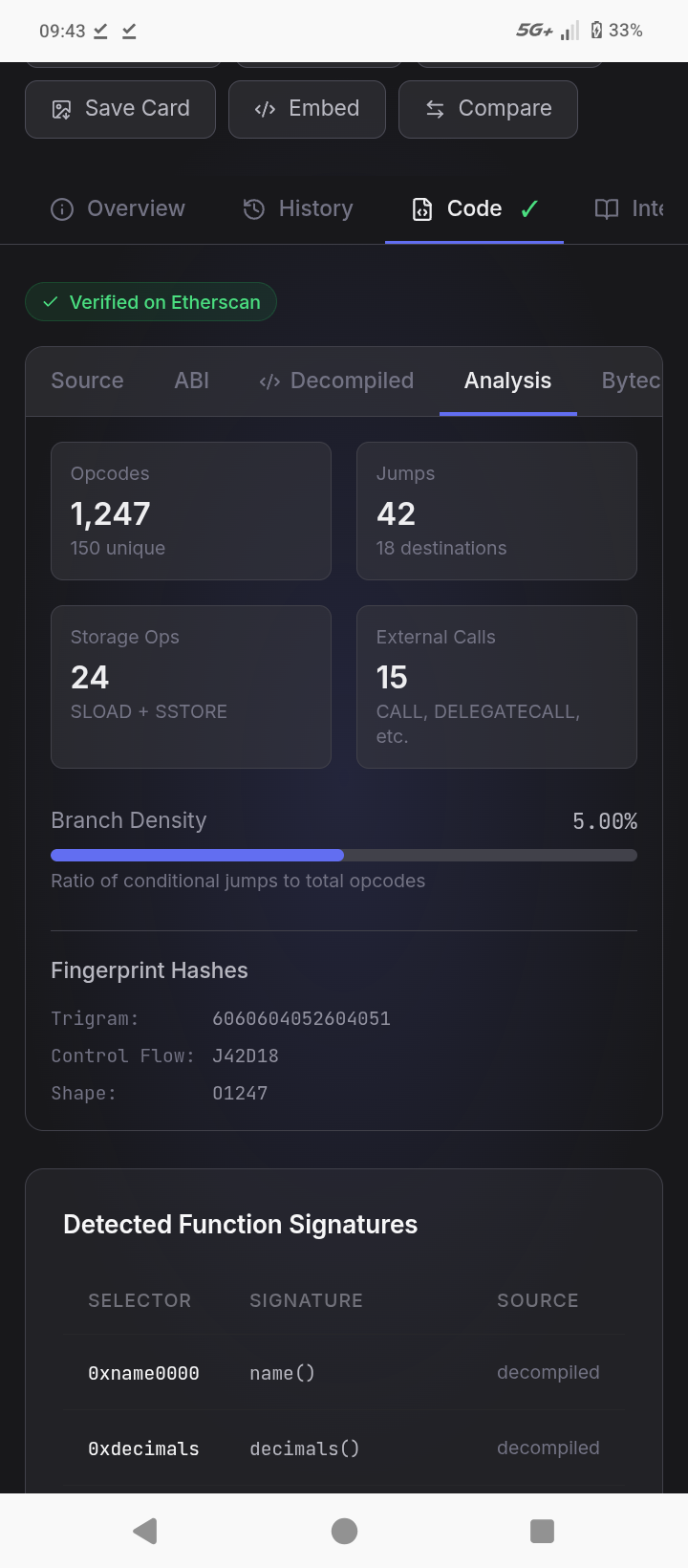
The following characteristics were detected through bytecode analysis and may not be accurate.
Frontier Era
The initial release of Ethereum. A bare-bones implementation for technical users.
Bytecode Overview
Verified Source Available
This contract has verified source code on Etherscan.
View Source Code